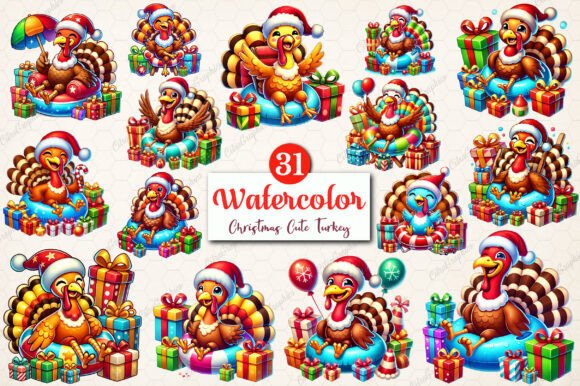
Watercolor Christmas Cute Turkey Clipart
As a designer who spends half her life staring at stitch charts and the other half troubleshooting tension issues, I don’t just look at a design; I look at how it will behave under the needle. When I first pulled up Watercolor Christmas Cute Turkey Clipart, my immediate thought wasn't about the holiday season itself, but about the technical translation of that soft, painterly aesthetic into thread. Watercolor effects are notoriously tricky in machine embroidery because they rely on subtle gradients and bleeding edges—elements that digital screens render effortlessly but physical thread struggles to replicate without looking muddy or cluttered.
This review is for the Etsy sellers, boutique owners, and craft fair veterans who are constantly hunting for unique assets that stand out in a sea of generic clipart. I want to walk you through my practical assessment of this illustration as a potential centerpiece for your next handmade product line, focusing on real-world application, visual impact, and the nitty-gritty of execution.
First Impressions: Mood and Visual Personality
The moment you see Watercolor Christmas Cute Turkey Clipart, it evokes a specific kind of cozy, festive warmth. Unlike the stark, high-contrast graphics often found in standard holiday collections, this piece feels softer, more organic, and distinctly "handmade" even before it hits the hoop. The watercolor style suggests a gentle approach to the Christmas theme, avoiding the aggressive reds and greens in favor of what appears to be a more nuanced, perhaps pastel or muted palette that feels modern and trendy.
For the creative entrepreneur, this mood is valuable. It signals quality and care. When a customer sees a design that looks like it was painted by hand rather than stamped out by a vector generator, their perception of the final product's value increases. This isn't just a turkey; it’s a character with personality. It fits naturally into the current market trend toward whimsical, nostalgic, and artisanal holiday decor. It feels less like a mass-produced item and more like a personalized gift from a friend, which is exactly the emotional hook that drives sales in the custom apparel and home goods sectors.
Real-World Application: Where Does It Shine?
In my experience, not every design works on every surface. After mentally mapping out various projects, I believe Watercolor Christmas Cute Turkey Clipart finds its true calling in medium-to-large format items where the detail can breathe. Here is where I would place this design for maximum impact:
- Custom Tote Bags and Canvas Totes: A large tote bag offers a perfect, flat canvas for a watercolor-style design. The fabric texture of canvas actually complements the "painted" look of the illustration, making the embroidery feel integrated rather than slapped on. It creates a chic, reusable holiday shopping bag that customers will actually want to use year after year.
- Baby Clothes and Nursery Decor: The "cute" factor here is undeniable. For baby onesies, bibs, or nursery wall hangings, the softness of the watercolor style is ideal. It doesn't overwhelm the delicate nature of baby products. A small embroidered patch of this turkey on a baby blanket adds a touch of sophistication that parents appreciate over loud, cartoonish graphics.
- Kitchen Towels and Tea Towels: This is an underrated category for holiday merchandise. A set of embroidered kitchen towels featuring this turkey brings a farmhouse-chic vibe to the holidays. The design’s layout likely allows for nice placement on the hem or center of the towel, creating a functional yet decorative item that sells well as a hostess gift.
- Sweatshirts and Hoodies: For those offering custom apparel, this design works beautifully on the front chest area or as a larger back print. The contrast between the cozy fleece of a sweatshirt and the intricate stitching of a detailed clipart design creates a premium tactile experience.
However, I must advise caution when considering this for embroidered patches intended for caps or hats. If the design includes fine, thin lines typical of watercolor effects, they may get lost or distort on the curved surface of a cap unless the digitizing is exceptionally precise.
Technical Considerations and Stitching Challenges
Let’s talk about the nuts and bolts. Translating a watercolor image into a machine embroidery design requires smart digitizing. If the original file is dense with tiny details, you need to ensure the stitch density isn't so high that the fabric pucks or the thread breaks. Conversely, if the digitizer simplifies the design too much, you lose the watercolor charm.
When evaluating this for production, pay close attention to the satin stitch borders. In watercolor styles, outlines are often soft. In embroidery, hard satin stitches can create a harsh border that clashes with the soft interior. Look for designs that use running stitch or fill stitch variations to mimic the brush strokes rather than solid blocks of color.
Fabric choice is critical here. Because the design relies on visual subtlety, it performs best on light-colored, stable fabrics. Dark fabrics can swallow up lighter thread colors, flattening the watercolor effect. If you must use dark fabric, consider using an applique design technique, where a base fabric is sewn down first, providing a clean background for the detailed embroidery. This also adds durability, which is essential for items that will undergo frequent washing, such as aprons or baby clothes.
Always test the hoop size compatibility. Large, detailed illustrations require larger hoops to maintain stability. Attempting to stitch a complex design in a small hoop can lead to distortion, especially if you are using stretchy knits for t-shirts. Use a proper stabilizer appropriate for your fabric type—cut-away for knits to prevent shifting, and tear-away for wovens to keep the back clean.
Design Assets and Commercial Use
For the Etsy seller or small shop owner, the versatility of this asset is key. Before purchasing or downloading, verify the licensing terms. Are you allowed to sell finished physical goods? Can you include this in a digital embroidery file bundle? Clarity here protects your business reputation. If the design is versatile enough to be used in both personal gifts and commercial merchandise, it offers a higher return on investment.
Consider how this design enhances your brand consistency. If your shop focuses on cute, rustic, or family-oriented holiday themes, this turkey clipart aligns perfectly. It helps build recognition. Customers who buy a matching set of a tote bag and a pillow cover featuring the same cohesive design are more likely to trust your brand and return for future purchases.
Final Verdict for the Practical Designer
Does Watercolor Christmas Cute Turkey Clipart earn a spot in your library? Yes, but with strategic planning. It is not a "throw-it-on-and-go" design for quick, low-cost items. It is a design meant for products where presentation matters. It elevates a simple tote bag design into a fashion statement and turns a basic holiday embroidery project into a keepsake.
My advice is to start with a scrap fabric test. Check the thread colors against your actual fabric stock. Sometimes a color that looks vibrant on screen appears dull in thread. Inspect the small details—are the eyes clear? Is the tail feather definition maintained? If the digitized version captures the essence of the watercolor while remaining structurally sound, you have a winner.
Ultimately, this clipart appeals to the buyer’s desire for something special. In a market flooded with generic holiday motifs, a design that feels artistic and tender stands out. It invites the viewer to slow down and appreciate the craft. For the maker, it offers a chance to showcase skill and taste. Just remember to respect the technical limitations of the medium, choose your fabrics wisely, and always prioritize the finish quality. When done right, this design can be the star of your holiday collection, driving engagement and sales through its undeniable charm and professional appeal.